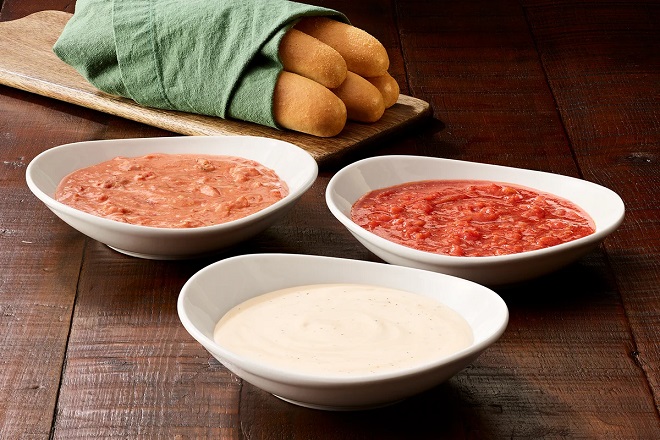
Olive Garden offers three main dipping sauces for breadsticks—Classic Marinara, Five Cheese Marinara, and Alfredo. The Marinara is the lightest at 90 calories per serving, the Five Cheese Marinara sits in the middle at 220 calories, and the Alfredo is the most indulgent at around 460 calories per serving.
There’s something almost ceremonial about the moment an Olive Garden server sets a basket of warm, glistening breadsticks on your table. Before you’ve even looked at the menu, before the salad arrives, before anyone has ordered—those breadsticks are already there. Soft, pillowy, glazed in a salty garlic topping. It’s a ritual that millions of diners look forward to every single visit.
But let’s be honest: half the experience comes down to what you’re dipping those breadsticks into. Olive Garden knows this, which is why they’ve built a small but mighty lineup of dipping sauces to go alongside them. Whether you’re dragging a breadstick through a pool of rich Alfredo or dunking it into a bright, tangy marinara, the sauce changes everything.
So what exactly goes into these sauces? And how do they stack up nutritionally? Whether you’re tracking your macros, curious about ingredients, or just trying to decide which sauce to order, this guide breaks it all down in plain English. We’re covering the breadsticks themselves, all three dipping sauces, and exactly what you’re eating when you pull up a chair at Olive Garden.
The Breadstick: The Star of the Show
Before we even get to the sauces, it’s worth talking about the breadstick itself—because no dipping experience is complete without understanding the vehicle.
Olive Garden’s breadsticks are made from a yeasted dough. The core ingredients are fairly simple: enriched wheat flour, water, yeast, sugar, soybean oil, and salt. Once baked, each stick gets brushed with a garlic topping made from margarine, garlic powder, and salt. One important note from Olive Garden’s official nutrition page: there is no dairy in the breadsticks or the breadstick topping. The garlic glaze is margarine-based, not butter-based—which surprises a lot of people.
The restaurant also confirms that its food recipes do not use added MSG, though some ingredients naturally contain glutamate (like tomatoes, cheese, and certain yeasts).
Here’s how the numbers break down, according to nutrition tracking data from CalorieKing and Eat This Much:
Breadstick Nutrition Facts
|
Plain Breadstick |
Breadstick with Garlic Topping |
|
|---|---|---|
|
Calories |
130 |
140 |
|
Total Fat |
1g |
2.5g |
|
Total Carbohydrates |
25g |
25g |
|
Protein |
4g |
4g |
On their own, breadsticks are relatively modest in calories. The garlic topping adds only a small amount of fat, given that the margarine is applied as a light brush rather than a heavy coating. The carbohydrate content is naturally higher since these are bread-based, but the protein count is decent for a side item.
The bigger consideration? Sodium. The salt in both the dough and the garlic topping means these breadsticks skew salty—which is part of why they taste so good, but also something worth keeping in mind if you’re watching your sodium intake.
The Three Dipping Sauces
Olive Garden currently offers three dipping sauces that pair with breadsticks: the Classic Marinara, the Five Cheese Marinara, and the Alfredo. Each one has a very different flavor profile, ingredient list, and nutritional footprint. Here’s everything you need to know about each.
Classic Marinara Dipping Sauce
The Classic Marinara is the lightest option on the table—both in terms of flavor and calories. It’s a straightforward tomato-based sauce built on crushed tomatoes, garlic, olive oil, herbs, black pepper, and a touch of sugar to balance the acidity. Some foodies and self-described former Olive Garden employees have noted on Reddit that the sauce uses a premade “battuto”—a frozen mince of vegetables like onion, celery, carrot, and garlic—combined with a prepared marinara base that’s heated in-house.
The flavor is bright and acidic, leaning heavily on tomato without much complexity to balance it out. Food critics at Tasting Table ranked it last among Olive Garden’s sauces, describing it as “a solid sauce, but a little boring and slightly acidic.” Still, for breadstick dipping purposes, that punchy tomato flavor can work really well—especially if you want something that doesn’t compete with the garlic.
Nutritionally, it’s a smart choice. At just 90 calories per serving, it’s low in fat and contains a decent 2g of dietary fiber from the tomatoes. The sodium is worth noting at 480mg per serving, which accounts for 20% of the recommended daily value.
Five Cheese Marinara Dipping Sauce
This is where things get more interesting. The Five Cheese Marinara takes the Classic Marinara as a base and blends in a generous handful of cheeses—typically a combination of mozzarella, Parmesan, Romano, Provolone, and Asiago. The result is a thicker, richer, creamier sauce that still carries the tomato backbone but wraps it in a layer of savory, melty cheese.
Olive Garden sells this sauce by the pint (serves about 8 people) for $800 calories total—breaking down to roughly 100 calories per portion if split evenly. However, as a standalone dipping serving, CalorieKing lists it at around 220 calories, which reflects a more realistic single-serve dip amount. It’s noticeably richer than the Classic Marinara, with 17g of total fat and 9g of saturated fat per serving. The cheese also bumps the protein up to 5g and adds 45mg of cholesterol.
Flavor-wise, this is the most crowd-pleasing of the three. The cheese cuts through the acidity of the tomato sauce, making it smoother and more indulgent without going full cream-sauce territory. Tasting Table ranked it third in their overall Olive Garden sauce ranking, calling it a strong option for those who want built-in creaminess without committing to Alfredo.
Alfredo Dipping Sauce
And then there’s the Alfredo. This is the crowd favorite for a reason—it’s essentially a rich, creamy, buttery sauce made from heavy cream, butter, Parmesan cheese, and garlic. The result is thick, velvety, and deeply savory. Breadstick into Alfredo is arguably the platonic ideal of the Olive Garden starter experience.
The caloric tradeoff is significant, though. At approximately 460 calories per serving and 27g of saturated fat (135% of the recommended daily value), the Alfredo sauce is by far the most indulgent of the three options. A full 85% of its calories come from fat, with only about 9g of net carbohydrates and 8g of protein rounding out the macros.
That said, when you’re at Olive Garden sharing breadsticks at the table, you’re rarely consuming an entire serving of Alfredo by yourself. Sharing it across a few people brings the nutritional impact down considerably.
Dipping Sauce Nutrition Facts at a Glance
Here’s a side-by-side comparison to make choosing easier:
|
Classic Marinara |
Five Cheese Marinara |
Alfredo |
|
|---|---|---|---|
|
Calories |
90 |
220 |
460 |
|
Total Fat |
5g |
17g |
~43g |
|
Saturated Fat |
0g |
9g |
27g |
|
Cholesterol |
0mg |
45mg |
— |
|
Sodium |
480mg |
540mg |
— |
|
Total Carbohydrates |
11g |
11g |
9g |
|
Dietary Fiber |
2g |
1g |
0g |
|
Sugars |
6g |
6g |
— |
|
Protein |
1g |
5g |
~8g |
Sources: CalorieKing, Eat This Much. Serving sizes and sodium for Alfredo sauce were not available in verified published data.
The contrast between the three sauces is striking when you see it laid out this way. The Marinara and Five Cheese Marinara have the same amount of carbohydrates (11g each) but very different fat profiles. The Alfredo is almost entirely fat-based, which is what gives it that luxurious, coating-your-mouth texture.
So Which Sauce Should You Go With?
Honestly? That depends on what you’re in the mood for—and what else you’re ordering.
If you’re going light or sharing a meal with a lot of courses, the Classic Marinara is the obvious pick. It adds flavor without weighing you down, and the acidity pairs well with the salty, garlicky breadstick. It’s also the only completely plant-based option of the three.
If you want something more decadent but still somewhat balanced, the Five Cheese Marinara hits that sweet spot. You get the richness of cheese, the brightness of tomato, and a more satisfying dip overall. It’s especially good if you’re planning to order a pasta dish with a lighter sauce and want to front-load some of the indulgence on the starter.
And if you’re going full Olive Garden experience—multiple courses, the endless salad, maybe a glass of wine—just get the Alfredo. It’s not an everyday nutritional choice, but as a restaurant treat shared around a table, it’s hard to beat. The flavor is rich, the dip is satisfying, and it turns a simple breadstick into something that feels genuinely luxurious.
One smart move that experienced Olive Garden diners swear by: ordering the Classic Marinara for dipping breadsticks, then choosing a different (richer) sauce for your actual pasta entrée. That way you get the variety without going overboard on any one sauce.
Breadsticks Are Just the Beginning
Olive Garden’s breadsticks and dipping sauces are one of those rare restaurant traditions that have genuinely stood the test of time. There’s a reason people talk about them the way they do, request extra baskets, and hunt down copycat recipes online. They’re simple, consistent, and executed well.
Understanding what’s in them doesn’t make them any less enjoyable—if anything, it helps you make a more intentional choice about how you want to build your meal. Whether you’re going low-calorie with the Classic Marinara or diving headfirst into the Alfredo, you’re now equipped with the full picture.
Order confidently, dip generously, and don’t let anyone judge you for asking for a second basket.