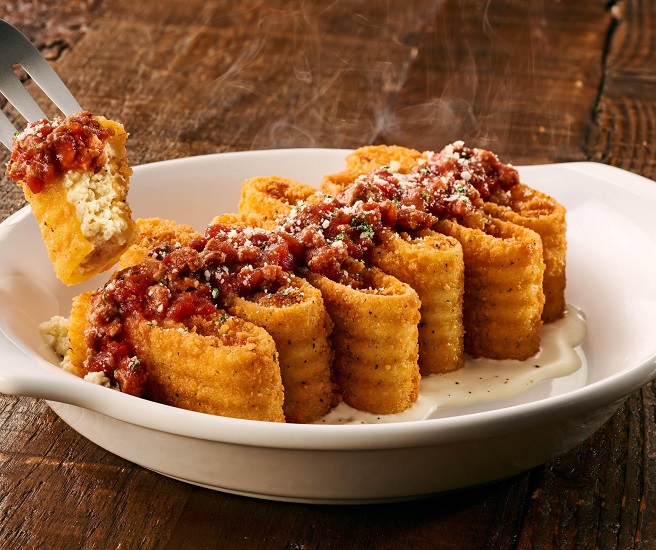
Olive Garden’s Lasagna Fritta is a deep-fried appetizer made from parmesan-breaded lasagna rolls filled with ricotta, mozzarella, and parmesan cheese, topped with Alfredo sauce and meat sauce. One order contains 1,130 calories, 76g of fat, 75g of carbohydrates, and 39g of protein.
Olive Garden has no shortage of crowd-pleasing menu items, but few generate as much curiosity as the Lasagna Fritta. Crispy on the outside, creamy and cheesy on the inside, and drowned in two different sauces—it’s the kind of appetizer that makes you forget you ordered it to share. If you’ve ever found yourself eyeing someone else’s plate at a nearby table, chances are this was it.
But what exactly goes into Lasagna Fritta? How does it stack up nutritionally? And if you’re trying to make a more informed dining decision, what do the numbers actually mean for your daily intake?
This guide breaks it all down. You’ll find a full ingredient breakdown, detailed nutrition facts, allergen information, and some useful context for understanding what you’re eating before you take that first bite. No judgment—just the facts.
What Is Olive Garden’s Lasagna Fritta?
Lasagna Fritta is a signature Olive Garden appetizer that takes the concept of traditional lasagna and deep-fries it. The name itself is Italian for “fried lasagna,” and that’s a pretty accurate description of what lands on your table.
Each order consists of several rolled lasagna noodles packed with a blend of Italian cheeses, coated in a parmesan breading, and fried until golden brown. They’re then plated and topped with Olive Garden’s house-made Alfredo sauce and a hearty meat sauce. A sprinkle of parmesan and toasted breadcrumbs finishes the dish, and it’s served hot, straight from the kitchen.
The result is a layered combination of textures: a crunchy, golden exterior gives way to a soft, cheese-filled interior, all brought together by two contrasting sauces—one creamy, one meaty. It’s rich, indulgent, and designed to be shared, though that last part is entirely optional.
Lasagna Fritta starts at $11.49 on the Olive Garden menu and is listed as an appetizer, though its calorie count is anything but light. More on that shortly.
What Are the Ingredients in Olive Garden’s Lasagna Fritta?
Understanding what goes into a dish helps you make better decisions about how it fits into your diet. Here’s a closer look at the core components of Lasagna Fritta.
The Lasagna Rolls
The base of the dish is built around lasagna noodles rolled around a dense, creamy cheese filling. That filling is a blend of several Italian cheeses, including ricotta, mozzarella, Parmesan, Romano, and Asiago. Each cheese brings something different to the table—ricotta provides the soft, creamy body, mozzarella adds stretch and mild flavor, and the harder aged cheeses (Parmesan, Romano, Asiago) contribute a sharp, salty depth that balances the richness of the rest.
Once rolled, the lasagna pieces are coated in a parmesan breading before being fried. This breading is what gives the dish its signature crunch and golden color, and it also contributes to the overall carbohydrate and fat content of the dish.
The Sauces
Two sauces top the fried lasagna rolls, and they couldn’t be more different from each other.
The first is Alfredo sauce, made with butter, heavy cream, parmesan, and garlic. It’s smooth, rich, and deeply savory—the kind of sauce that coats every surface it touches. The second is Olive Garden’s house-made meat sauce, which features pan-seared beef and Italian sausage. This sauce adds a heartier, more robust flavor that cuts through the creaminess of the Alfredo.
Together, the two sauces create a combination that’s both indulgent and complex. Neither overwhelms the other; instead, they layer on top of the crispy rolls to create a cohesive bite.
The Finishing Touches
To complete the dish, Olive Garden adds a garnish of toasted breadcrumbs and fresh parsley. The breadcrumbs reinforce the textural contrast between crispy and soft, while the parsley adds a touch of color and freshness that cuts through the heaviness of the dish.
Here’s a summary of the key ingredients at a glance:
|
Component |
Ingredients |
|---|---|
|
Lasagna filling |
Ricotta, mozzarella, Parmesan, Romano, and Asiago cheeses |
|
Breading |
Parmesan-seasoned breadcrumb coating |
|
Alfredo sauce |
Butter, heavy cream, Parmesan, garlic |
|
Meat sauce |
Pan-seared beef, Italian sausage |
|
Garnish |
Toasted breadcrumbs, fresh parsley |
Olive Garden Lasagna Fritta Nutrition Facts
Now for the part that surprises most people. Lasagna Fritta is not a light dish—and if you’re watching your calorie or sodium intake, it’s worth knowing exactly what you’re getting into.
According to Olive Garden’s official U.S. Nutrition Information, one full order of Lasagna Fritta contains the following:
|
Nutrient |
Amount Per Serving |
% Daily Value* |
|---|---|---|
|
Calories |
1,130 cal |
57% |
|
Total Fat |
76g |
97% |
|
Saturated Fat |
29g |
145% |
|
Trans Fat |
1.5g |
— |
|
Cholesterol |
160mg |
53% |
|
Sodium |
1,650mg |
72% |
|
Total Carbohydrates |
75g |
27% |
|
Dietary Fiber |
5g |
18% |
|
Sugars |
4g |
— |
|
Protein |
39g |
— |
*Percent Daily Values are based on a 2,000-calorie diet.
A few numbers stand out immediately. At 1,130 calories, a single order of Lasagna Fritta accounts for more than half of the average adult’s recommended daily calorie intake. The fat content is equally notable—76 grams of total fat puts this dish at nearly 100% of the recommended daily fat intake, with saturated fat alone exceeding the daily recommended limit at 145% of the Daily Value.
The sodium figure also deserves attention. With 1,650mg of sodium, one order of Lasagna Fritta provides about 72% of the recommended daily sodium intake. For those managing blood pressure or following a low-sodium diet, that’s a meaningful consideration.
On the other side of the ledger, Lasagna Fritta does deliver 39 grams of protein—a solid amount, largely thanks to the meat sauce and the multi-cheese filling. There’s also a modest 5 grams of dietary fiber, which comes primarily from the pasta itself.
How Does the Calorie Breakdown Look?
The macronutrient distribution of Lasagna Fritta is heavily skewed toward fat. Of the 1,130 total calories:
- 60% come from fat
- 26% come from carbohydrates
- 14% come from protein
This makes Lasagna Fritta a high-fat, moderate-carbohydrate appetizer rather than a protein-forward dish, despite its decent protein count. The combination of deep-frying, a cheese-heavy filling, and two rich sauces accounts for the lopsided fat percentage.
For comparison, the American Heart Association recommends that saturated fat make up no more than 5–6% of total daily calories. A single serving of Lasagna Fritta contains 29 grams of saturated fat—more than most adults should consume in an entire day.
That said, context matters. Lasagna Fritta is an appetizer, and Olive Garden’s menu lists it as a shareable dish. Split between two or three people, the numbers become considerably more manageable.
Allergen Information: What to Know Before You Order
Lasagna Fritta contains several of the most common food allergens, so it’s worth reviewing these carefully if you or someone in your party has dietary restrictions.
The dish contains:
- Milk (present in the cheese filling, Alfredo sauce, and breading)
- Wheat/Gluten (present in the lasagna noodles and breading)
- Eggs (present in the pasta and breading)
- Soy (present in various components of the dish)
Olive Garden also notes that Lasagna Fritta is prepared in shared kitchen environments, which means cross-contact with other allergens—including tree nuts, peanuts, and shellfish—is possible. If you have a severe allergy, it’s always best to speak directly with a server or the kitchen before ordering.
For those following specific dietary patterns: Lasagna Fritta is not suitable for vegans or vegetarians due to the meat sauce and the multi-cheese filling.
Is Lasagna Fritta Worth Ordering? What the Nutrition Tells You
This is the practical question, and the honest answer is: it depends on how you’re eating that day.
If Lasagna Fritta is the starting point for a larger Olive Garden meal that includes pasta, soup, salad, and breadsticks, the cumulative calorie and sodium count can climb very quickly. On that kind of visit, treating Lasagna Fritta as a true appetizer—something to share between two or more people—keeps things in better proportion.
On the other hand, if Lasagna Fritta is the main event—ordered as a standalone meal rather than a starter—its 39 grams of protein and high caloric density make it fairly filling. Some diners report ordering it as a meal in itself, particularly for lunch portions or lighter dining occasions.
It’s also worth noting that Olive Garden allows some customization at certain locations. Guests who prefer to skip the meat sauce can request a version without it, making the dish slightly lighter and suitable for those avoiding red meat.
The bottom line: Lasagna Fritta is a genuinely indulgent dish. It earns a Nutri-Score E (the lowest possible rating on the European nutritional quality scale), reflecting its high levels of saturated fat, sodium, and overall energy density. That doesn’t mean it should never be ordered—but it does mean it’s best enjoyed occasionally, with a clear picture of what’s in it.
Make the Most of Your Olive Garden Visit
Now that you have the full picture on Lasagna Fritta—its ingredients, macros, allergens, and nutritional profile—you’re in a much better position to decide how it fits into your meal. Knowledge doesn’t have to take the fun out of dining out; it just helps you make choices that work for you.
If you’re planning an Olive Garden visit, consider pairing Lasagna Fritta with lighter menu items to balance things out. Their Garden Salad (with dressing on the side) and Minestrone Soup are among the lower-calorie options on the menu, and they pair well as part of a more balanced meal.
And if you’re the type who loves recreating restaurant dishes at home, Lasagna Fritta is actually one of the more approachable copycat recipes out there. The core technique—rolled lasagna noodles, cheese filling, parmesan breading, and a pan-fry—can be adapted to suit different dietary needs without losing what makes the dish special.
Either way, you’re now equipped with everything you need to enjoy it on your own terms.