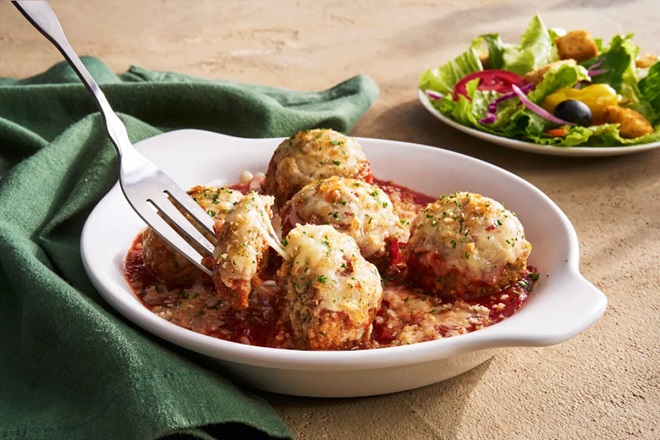
If you’ve ever sat down at Olive Garden and found yourself staring at the appetizer menu, there’s a good chance the Meatballs Parmigiana caught your eye. Big, golden-brown meatballs smothered in marinara, blanketed in a bubbling Italian cheese blend, and finished with toasted breadcrumbs — it’s the kind of dish that’s hard to say no to.
But before you dig in, you might be wondering what you’re actually eating. How many calories are in a serving? What goes into those meatballs? And how does this appetizer stack up against your daily nutritional needs? These are fair questions, especially if you’re trying to stay on top of what you eat — even when you’re dining out.
That’s exactly what this post is here for. We’re breaking down everything you need to know about Olive Garden’s Meatballs Parmigiana, from the key ingredients that make up the dish to the full nutrition label straight from Olive Garden’s official data. No guesswork, just the facts — so you can decide if this is the dish for you.
Whether you’re a loyal Olive Garden regular or someone who’s curious about what’s behind the menu, this one’s worth a read.
What Is Olive Garden’s Meatballs Parmigiana?
Olive Garden’s Meatballs Parmigiana is listed on the menu as an appetizer, though let’s be honest — it’s hearty enough to pass as a full meal. The dish features large, hand-crafted meatballs served over a rich marinara sauce and topped with a generous amount of melted Italian cheeses and crispy toasted breadcrumbs.
It’s a classic Italian-American comfort dish, and Olive Garden does it in a way that’s both indulgent and satisfying. The meatballs are tender on the inside, slightly browned on the outside, and packed with savory flavor. The marinara is bright and herby, the cheese is gooey and golden, and the toasted breadcrumbs add just enough crunch to pull everything together.
One serving clocks in at 545 grams — that’s a substantial plate of food for what’s technically a starter.
What’s in Olive Garden’s Meatballs Parmigiana?
Olive Garden doesn’t publicly share its proprietary recipes, but based on the dish’s composition, traditional Italian-American cooking techniques, and the restaurant’s own descriptions, here’s a breakdown of the key components you can expect.
The Meatballs
The base of this dish is, of course, the meatballs themselves. Olive Garden’s version is made from a blend of seasoned ground meat — typically a mixture of beef and pork — which gives them a rich, juicy texture. The meat mixture is combined with:
- Italian breadcrumbs — for binding and a subtle seasoned flavor
- Parmesan cheese — grated into the mix for a nutty, savory depth
- Fresh parsley — for brightness and color
- Minced garlic — a non-negotiable for any Italian-inspired meatball
- Egg — to hold everything together
- Seasonings — including salt, black pepper, and dried oregano
The meatballs are baked until cooked through, giving them a firm exterior while keeping the inside tender and moist.
The Marinara Sauce
Underneath those meatballs is a classic marinara. Olive Garden’s version is smooth, slightly sweet, and well-seasoned — the kind of sauce that tastes like it’s been simmering all day. Key components typically include crushed tomatoes, garlic, onion, olive oil, and a blend of Italian herbs like basil and oregano. A small touch of sugar helps balance the acidity of the tomatoes.
The Cheese Topping
This is where the “Parmigiana” comes in. Olive Garden tops the dish with an Italian cheese blend that includes mozzarella, provolone, Asiago, Romano, and Parmesan — five cheeses that melt together into a decadent, creamy layer. This topping is what makes the dish feel truly special, adding both richness and a slightly sharp, savory finish.
Toasted Italian breadcrumbs are scattered over the top just before serving, adding a contrasting crunch to all that melted cheese.
Olive Garden Meatballs Parmigiana: Nutrition Facts
Now for the part you’ve probably been waiting for. Here’s the complete nutrition label for one serving of Olive Garden’s Meatballs Parmigiana, sourced directly from Olive Garden’s official nutrition data (via the restaurant’s published nutrition PDF).
One serving = 1 menu item (545g)
|
Nutrient |
Amount Per Serving |
|---|---|
|
Calories |
1,040 kcal |
|
Total Fat |
83g |
|
Saturated Fat |
40g |
|
Trans Fat |
3.5g |
|
Cholesterol |
145mg |
|
Sodium |
2,800mg |
|
Total Carbohydrates |
27g |
|
Dietary Fiber |
6g |
|
Total Sugars |
5g |
|
Protein |
51g |
Take a moment to let those numbers sink in. This appetizer alone contains over 1,000 calories — more than half the daily intake recommendation for many adults (based on a 2,000-calorie daily diet). The fat content is particularly striking, with 83 grams of total fat making up 71% of the dish’s total calories.
On the flip side, the protein content is genuinely impressive. At 51 grams per serving, the Meatballs Parmigiana delivers more than a full day’s recommended protein in a single sitting. For anyone focused on building muscle or simply keeping hunger at bay, that’s not nothing.
Breaking Down the Numbers
Let’s go a step further and look at how this dish measures up against your recommended daily values.
|
Nutrient |
Amount |
% Daily Value |
|---|---|---|
|
Total Fat |
83g |
106% |
|
Saturated Fat |
40g |
200% |
|
Trans Fat |
3.5g |
— |
|
Cholesterol |
145mg |
48% |
|
Sodium |
2,800mg |
117% |
|
Total Carbohydrates |
27g |
10% |
|
Dietary Fiber |
6g |
21% |
|
Total Sugars |
5g |
— |
|
Protein |
51g |
102% |
% Daily Values are based on a 2,000-calorie diet.
A few things stand out here, so let’s talk through them.
Sodium: The Biggest Watch-Out
The sodium content is the most eye-catching figure on this label — 2,800mg in a single appetizer. That’s 117% of the recommended daily limit in one dish. The American Heart Association recommends no more than 2,300mg of sodium per day for most adults, and ideally closer to 1,500mg for those with high blood pressure or heart concerns.
This is pretty common territory for restaurant meals, where sodium is used generously for flavor, but it’s something to keep in mind if you’re watching your salt intake. If this is your starter and you’re still ordering a pasta dish on top of it, your sodium count for the day will climb significantly.
Saturated Fat: Worth Paying Attention To
The 40 grams of saturated fat here equals 200% of the recommended daily value — meaning this dish alone contains twice the amount of saturated fat most adults should have in an entire day. The combination of fatty ground meat, generous amounts of cheese, and a five-cheese topping is what drives this number up.
Occasional indulgences are totally fine, but if you’re eating this regularly or pairing it with other high-fat foods in the same meal, it’s worth being aware of.
Protein: A Genuine Bright Spot
Here’s the good news: 51 grams of protein is a lot. Most adults need somewhere between 46 to 56 grams of protein per day as a baseline, and the Meatballs Parmigiana covers that in full. The combo of meat, egg, and multiple cheeses makes this a protein-rich dish, even if it comes packaged with a lot of fat and sodium alongside it.
Carbohydrates: Lower Than You Might Expect
With only 27 grams of total carbs (and 6 grams of fiber), this dish is actually relatively low in carbohydrates compared to most Italian restaurant offerings. If you were expecting a carb-heavy meal, this one might surprise you. The breadcrumbs contribute most of the carbs here, but they’re a minor component of the overall dish.
How Does It Fit Into Your Daily Diet?
At 1,040 calories, this appetizer represents roughly 52% of a 2,000-calorie daily budget. That means if you’re ordering this as a starter and then following it up with a pasta entrée and a glass of wine, your total meal could easily land somewhere between 1,800 and 2,500+ calories — all in one sitting.
That doesn’t mean you can’t enjoy it. Eating out is one of life’s genuine pleasures, and no single meal defines your overall diet. But it does help to know what you’re working with, especially if you’re planning to eat mindfully throughout the rest of the day.
One practical approach? Share the Meatballs Parmigiana with your table. It’s filling enough to serve as a shared starter for two or three people, which cuts the individual calorie and sodium load significantly. You’ll still get all the flavor — just without eating the full 545g yourself.
Allergen Information
If you have food allergies or intolerances, the Meatballs Parmigiana contains several of the major allergens you’ll want to know about. Based on the dish’s known ingredients, this item contains:
- Wheat — from the Italian breadcrumbs
- Dairy (Milk) — from the multiple cheeses used throughout
- Eggs — used in the meatball mixture
Olive Garden also uses highly refined canola or soy oil in their kitchen operations, and the restaurant notes that it cannot guarantee any menu item is entirely free of allergens due to the potential for cross-contact in the kitchen. If you have a serious allergy, always let your server know before ordering, and consider checking Olive Garden’s official allergen guide for the most up-to-date information.
A Few Tips for Enjoying It
Knowing the nutrition facts doesn’t mean you have to skip this dish altogether — it just means you can approach it a little more intentionally. Here are a few simple ways to enjoy the Meatballs Parmigiana without going completely overboard:
- Share it. This is genuinely a dish that works well as a shared appetizer. Split it between two people and the numbers look a lot more manageable.
- Skip the breadsticks on the side. Olive Garden’s breadsticks are iconic, but if you’re already having a sodium-heavy appetizer, holding off on the extras helps balance things out.
- Go lighter on your entrée. If you know you’re ordering the Meatballs Parmigiana to start, consider a lighter pasta or a soup and salad for your main. That way you get to enjoy the dish without feeling like you’ve overdone it.
- Drink plenty of water. With nearly 3,000mg of sodium, you’ll want to stay well hydrated throughout your meal.
The Bottom Line
Olive Garden’s Meatballs Parmigiana is a genuinely delicious dish — rich, satisfying, and packed with bold Italian-American flavor. But it comes with a significant nutritional footprint. The 1,040 calories, 83g of fat, and 2,800mg of sodium make this one of the heavier appetizers on the menu, and it’s not something you’d want to eat in its entirety on a regular basis if you’re paying close attention to your diet.
That said, food is meant to be enjoyed — and knowing exactly what’s in your meal puts you in the driver’s seat. Whether you’re sharing it at a family dinner, treating yourself to a night off from cooking, or just curious about what’s in your favorite Olive Garden starter, you’re now fully equipped with the facts.